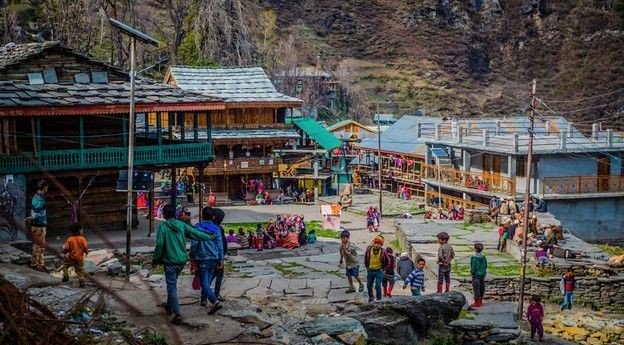
Reached only on foot, up a steep trail from the Parvati valley, Malana sits in a fold of the mountains that has kept it more isolated than almost any other inhabited village in Kullu district — and that isolation shows in ways that go well beyond geography. The village speaks Kanashi, a language unrelated to the Pahari dialects of surrounding valleys and, by most linguistic accounts, not clearly related to any major regional language family, spoken by essentially no one outside the village itself.
Malana’s governance is equally distinct. The village operates under a traditional council system centred on its local deity, Jamlu Devta, whose word, delivered through an oracle, carries real authority in settling disputes and making community decisions, functioning alongside — and, in the eyes of villagers, often above — the formal Indian legal and administrative system that technically governs the area. This parallel system of local law is one of the most-discussed aspects of Malana for outside visitors, though it is, for residents, simply the way disputes have long been resolved.
Physical separation from outsiders is built into village custom as well. Visitors are traditionally asked not to touch the walls of houses or temples, and in the temple precinct in particular, contact with structures or objects considered sacred is treated seriously, with a fine traditionally levied against anyone who violates the custom, whether inadvertently or not. These rules are not presented for tourists’ benefit; they reflect a genuinely older set of beliefs about ritual purity that predate the trekking routes that now bring a steady trickle of visitors past the village each season.
The origins of Malana’s distinctiveness are debated rather than settled. Local tradition offers several accounts, including one connecting the village’s ancestry to soldiers from Alexander the Great’s army who are said to have settled in the valley — a claim without solid historical documentation, but one that persists locally and has fed a certain amount of outside curiosity about the village’s unusual language and customs.
In more recent decades, Malana has also become known, less happily, for a strain of locally grown cannabis considered among the most potent in the region, a reputation that has drawn a very different kind of visitor and created real tension with both law enforcement and the village’s own effort to be understood on its own terms, as a community with a language, a legal tradition and a set of customs that have persisted largely on their own, with minimal outside interference, for a very long time.
