Kangra painting belongs to the wider family of Pahari miniature art produced across the hill states of the western Himalaya, but it is generally considered, by art historians, to represent the style’s most refined and lyrical expression. Its rise is closely tied to a specific ruler and a specific moment: Raja Sansar Chand II, who governed Kangra state from the 1770s and brought the kingdom to its greatest territorial and cultural extent, actively drawing painters to his court and commissioning work on a scale that established Kangra as a genuine centre of production rather than merely a patron of art made elsewhere.
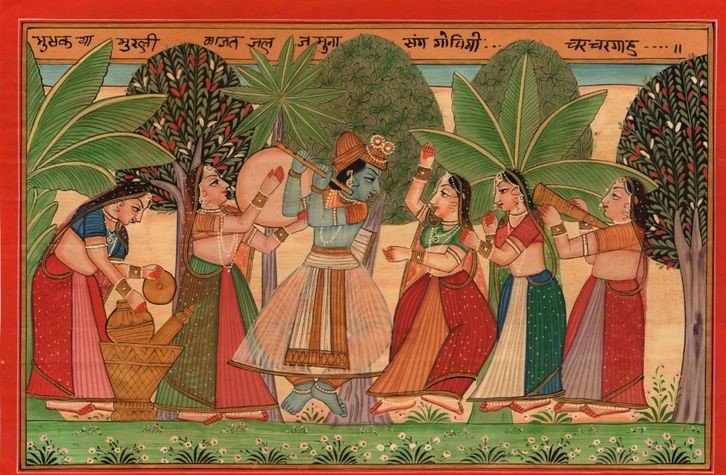
Much of that court’s most celebrated work took its subject matter from Vaishnavite devotional poetry — particularly the life of Krishna as told in texts like the Bhagavata Purana and Jayadeva’s Gita Govinda — rendered in a style marked by soft, naturalistic colour, delicate line work, and a distinctive tenderness in depicting figures, landscape and emotion together, rather than treating them as separate elements of a composition.
The painter most closely associated with elevating this style is Nainsukh, who worked initially for the court of Guler, a neighbouring hill state, before his family’s tradition of painting became deeply intertwined with Kangra’s own workshop under Sansar Chand’s patronage. Nainsukh’s work is noted for an unusually observational, almost documentary quality even within devotional or courtly scenes, a naturalism that set a benchmark other Pahari painters worked to match.
The style’s golden period did not last. Sansar Chand’s kingdom was significantly weakened by conflict with neighbouring hill states and, eventually, by the Gorkha invasion of the early 19th century, and court patronage on the earlier scale did not fully recover. Many of the painters and their descendants dispersed to other hill courts, carrying Kangra techniques and sensibilities with them, which is part of why the style’s influence can be traced across several other Pahari painting traditions well beyond Kangra itself.
Today, surviving Kangra paintings are held mostly in major museum collections rather than in the district itself, though smaller collections and reproductions can still be seen locally, including at institutions in the district that preserve examples of the tradition. The valley’s identification with the style remains strong regardless — a reminder that for a few decades in the 18th century, a relatively small hill kingdom produced some of the most delicate devotional art the subcontinent has seen.