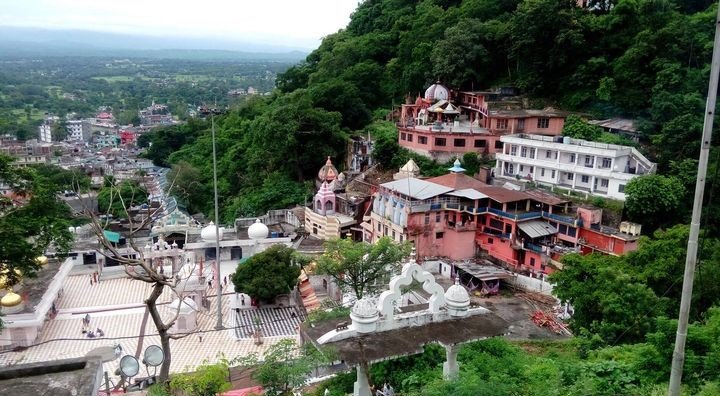
Most Hindu temples are built around an idol, a carved or cast image of the deity that becomes the focus of ritual and worship. The Jwalamukhi temple in Kangra district breaks with this entirely: its object of worship is a cluster of small natural gas flames, said in local tradition to have burned continuously and without any external fuel since long before recorded history, emerging directly from fissures in the rock.
The temple is counted among the Shakti Peethas, a network of sites across the subcontinent associated, in Hindu mythology, with the scattered body parts of the goddess Sati following her self-immolation and Shiva’s subsequent grief-stricken wandering with her body. Jwalamukhi is traditionally identified with the tongue of the goddess, and the flame itself is understood as her direct, living manifestation — Jwala Mukhi translates roughly as “flaming mouth.”
The temple’s wealth and prominence made it a repeated target through the medieval period, most notably during Mahmud of Ghazni’s raids into northern India in the 11th century, when the temple treasury is recorded as having been plundered. Centuries later, Mughal emperor Akbar is said, in local tradition, to have visited the temple and, sceptical of the flame’s supposed inextinguishability, attempted unsuccessfully to have it doused with water and cut off with a canal, before eventually offering a gold umbrella to the shrine in a gesture of acknowledgment — an object local tradition holds later turned, mysteriously, to a base metal.
In geological terms, the flames are natural gas seepage igniting at the surface, a phenomenon found in a small number of other locations worldwide but which was, understandably, interpreted in wholly different terms in earlier centuries. Modern temple management has, if anything, made the flames more consistent and controlled than a purely natural seep would be, but the core religious understanding of the site — a living, un-lit, un-fed fire as the direct presence of the goddess — remains unchanged by that context.
Today, Jwalamukhi draws a continuous flow of pilgrims, with particularly large crowds during Navratri, and functions as one of the most visited religious sites in Kangra district alongside the Vajreshwari and Chamunda temples. For visitors regardless of religious background, it remains one of the more unusual sacred sites in the Himalaya: a shrine with no statue to view, only fire, tended and witnessed rather than depicted.
